Global Irish Industries
In the WoodsGlobal Irish Industries is one of three companies that Sam O'Neill traces through layers of holding companies to land around the planned motorway at Knocknaree. Its land position tied the company to the route’s potential development value: a more distant alternative could sharply reduce the worth of industrial property near the original alignment. The investigation presents Global as part of a larger land-acquisition and rezoning network, while leaving the company’s precise actions and the identities behind its ownership only partly established.
Identity and ownership
Sam’s map divides the land around the motorway corridor into colored blocks: blue for Global Irish Industries, green for Futura Property Consultants, and red for Dynamo Development. The blocks represent a complicated ownership trail. Many of the apparent buyers were holding companies nested within other companies, and Sam said that tracing the true owners had consumed much of his investigative time. He traced the purchases back to these three firms, but had difficulty determining who stood behind them. Two were registered in the Czech Republic, while Futura was registered in Hungary; the account does not specify which two were Czech-registered.
The company’s name also appears in a small silver-paper note passed to Sam by the reporter Kiely. The note attributed Global to Jeffrey Barnes and Conor Roche. Sam regarded Kiely as eccentric but as a capable reporter, and thought he would not have supplied the names without confidence in them. The note thus offered a lead about people allegedly behind the company, not a complete or independently demonstrated account of its ownership.
Land purchases and rezoning
Sam’s reconstruction places Global alongside Futura and Dynamo in acquiring almost all the land around the relevant stretch of the proposed motorway. The plans were announced in March 2000. Four local farmers held on to their parcels while other landowners accepted offers above the going rate for agricultural land, hoping to discover why the buyers wanted the property. The motorway made the area more accessible and raised the prospect of industrial estates and residential development.
The four farmers sought rezoning themselves, but the county council rejected their applications each time. One farmer, Maurice Cleary, applied four times. After a representative of a holding company warned him that a pharmaceutical plant beside his farm could expose his cattle to chemical waste, Cleary took the warning as a threat and sold. Sam could not establish whether Cleary’s interpretation was correct. The farmers ultimately sold for prices comparable to those paid to other sellers: favorable for agricultural land, but well below its possible industrial or residential value. Once the three companies had acquired the land, they applied for rezoning and their applications were granted.
Route value and the wider investigation
Sam suspected that the companies had a substantial financial reason to oppose moving the motorway, although he could not prove the full extent of their influence. He reported that the council gave him no direct answers about its rezoning decisions, and read the sequence of approvals as possible evidence of favoritism. The account presents that suspicion as an investigative conclusion, not as a proven finding about Global Irish Industries specifically.
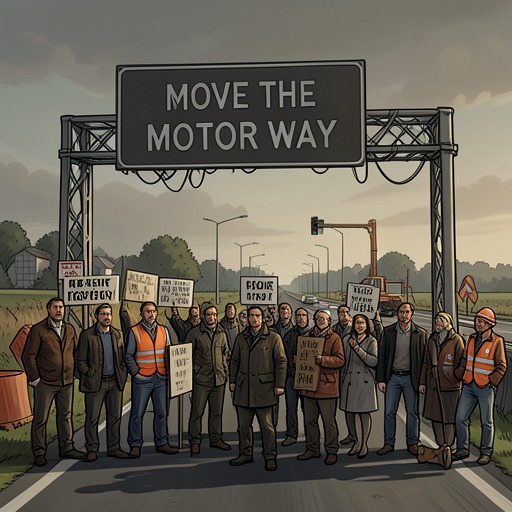
A survey identified a logical alternative motorway route promoted by the Move the Motorway campaign. It lay roughly two miles from the original route, and four or five miles away in some places. Land north of the proposed alignment would remain accessible, but holdings to the south would lose value. Estate agents told Sam that industrial land beside the motorway could be worth up to twice as much as comparable land three miles away; he estimated that the difference across the holdings could amount to millions. The map therefore makes visible the possible private benefit attached to a public infrastructure decision, while also showing why the three companies’ shared land position drew scrutiny.
The investigation’s other clues identify individuals associated with the broader development story but do not by themselves establish Global’s direct participation in threats or other criminal acts. In a recording, Terence Andrews angrily complained about injunctions and payments connected to getting the project back on track. The silver-paper note separately linked Andrews to Futura, and named Barnes and Roche in connection with Global. These details sharpen the picture of overlapping commercial interests, but the evidence leaves the exact relationships among the companies, their named associates, and the alleged pressure around the motorway unresolved.